Open Knowledge Initiatives, IIIT-Hyderabad
Sudden Rise of Telugu Book Reading
- By Pavan Santhosh (OKI, IIIT-H)
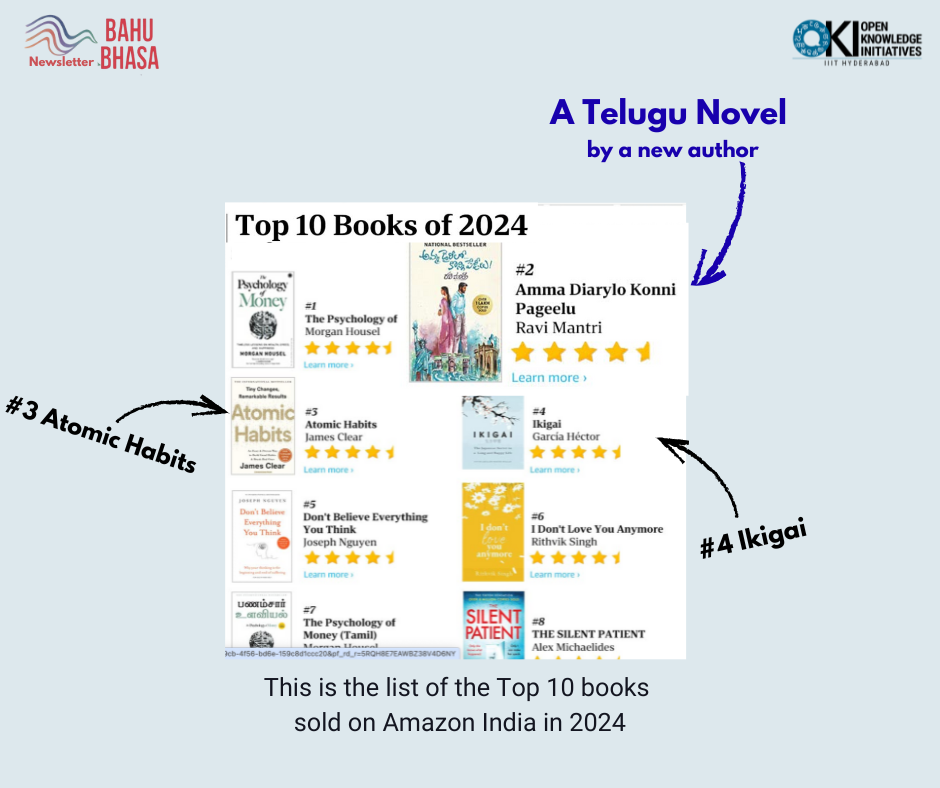 Image Credits: By Pavan Santhosh S - Derived work, Used under fair use for educational purposes
There is a general perception that book reading in Indian languages is in decline. Anecdotes, personal experiences, and available data shape this understanding. With the rise of digital content, even English book reading has seen a decline, leading many to assume that Indian languages would be hit even harder. But what if you discovered that one Indian language is witnessing a resurgence in reading habits, not in self-help or competitive exam books, but in fiction?
Yes, that is exactly what is happening.
What was a rare habit just a couple of years ago has now been embraced by scores of new readers. In an industry where selling 2,000–4,000 copies over a year is considered a major success, recent bestsellers are now selling in the tens of thousands. One book has even crossed 1,75,000 copies within just a year and a half.
Let’s explore what’s happening with Telugu books and their new generation of readers: Read more
- Curated by Subodh Kulkarni (OKI, IIIT-H)
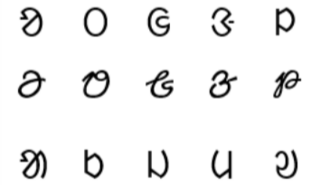
Santali Transliteration System released on Chrome Webstore The Santali Transliteration system is now available on the Chrome Web Store. SITIŃ Converter is a browser extension for converting text and documents from Ol Chiki to Roman Santali. The tool is developed by Edward Soren. Contributed by: Rahi Soren Image Credits: By Drmccreedy - Own work, CC BY-SA 4.0 Assamese enters AI platform BharatGen 2 Guwahati-based NGOs, Assam Jatiya Bidyalay Educational & Socio-Economic Trust and Nanda Talukdar Foundation, in partnership with IIT Bombay’s BharatGen initiative, will add two million pages of Assamese content to BharatGen, making Assamese the 10th language supported by the government-backed AI model.
MORE DETAILS: News article Contributed by: Kabyanil Talukdar
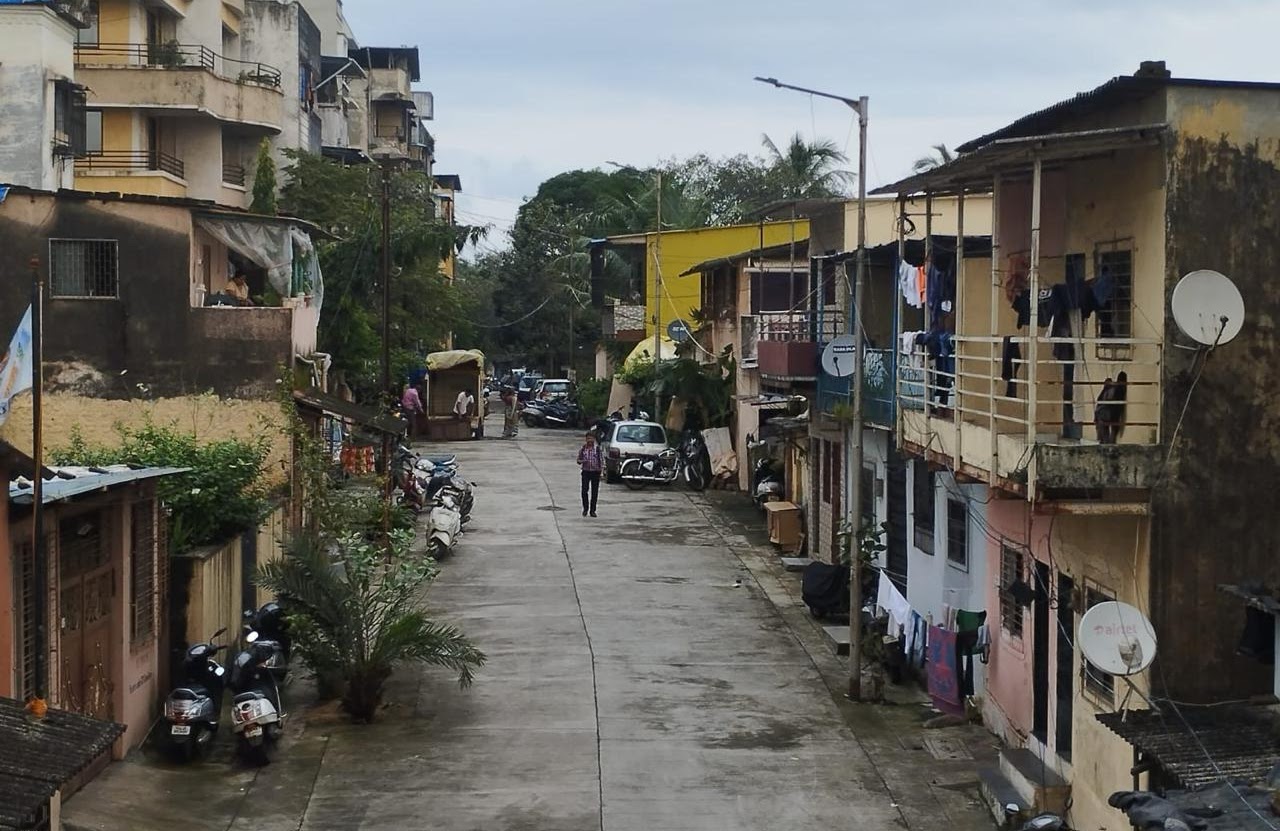
| Barracks of Ulhasnagar: An Oral History of a Refugee City This project documents everyday Sindhi refugee experiences in Ulhasnagar through oral histories on housing and community life. By recording and sharing interviews in Sindhi (along with Marathi, Hindi, and English) on Wikimedia Commons and a dedicated website, the project preserves spoken Sindhi and increases the visibility of Sindhi history online. The project is led by Dr. Soni Wadhwa (SRM University) with Mala Parchani (Bhashini, IIT Madras).
MORE DETAILS: Website and Wikimedia Commons. Contributed by: Dr. Soni Wadhwa Image Credits: By Mala Parchani - Own work, Used under fair use for educational purposes
World Record Set with 1,678 Indigenous Language Posters at Pune Rise Foundation, in collaboration with Pune Book Festival, made a Guinness World record for the display of 1678 posters depicting indigenous language words on 12 December 2025).
MORE DETAILS: News article Contributed by: Rushikesh Khilare |
Reflections from Bahu Bhasa 2025 & What’s Next Over the past few weeks, we’ve been carefully reading and discussing the feedback shared by the Bahu Bhasa Network. Thank you for taking the time to reflect and write back — your inputs have been thoughtful, encouraging, and deeply useful. We wanted to share a few broad takeaways and let you know how this feedback is shaping our next steps. What we heard from Bahu Bhasa 2025 participants:
- Bahu Bhasa was widely seen as a meaningful beginning, not just an event, but a space with the potential to grow into a sustained, long-term effort.
- The opportunity for cross-language and cross-community interaction stood out strongly, especially for participants working with underrepresented languages and scripts.
- Many of you valued the informal yet rich conversations, which allowed for sharing practices, challenges, and experiences beyond formal presentations.
- There was clear interest in continued engagement, follow-up collaborations, and contributing to future activities or shared outputs.
- The intersections of language, technology, education, and access emerged repeatedly as areas that deserve deeper, more structured attention.
- Several responses also highlighted the importance of better documentation and synthesis, so that insights from such gatherings can travel beyond those who were present.
What we’re doing now: Our team is currently working through this feedback in detail and using it as a key input for planning the next phase of Bahu Bhasa. Rather than treating these reflections as retrospective, we see them as a roadmap. Starting January 2026, we plan to launch a series of online workshops shaped directly by this feedback. These sessions will focus on important skills, practices, and perspectives that strengthen and enrich Indic languages, spanning documentation, tools, community practices, and knowledge-sharing. We’ll share more details soon, but for now, we want you to know that your voices are being heard and actively carried forward. Bahu Bhasa is evolving as a network because of this collective thinking, and we’re excited to continue this journey together. Stay tuned, and as always, thank you for being part of Bahu Bhasa.
List of some of the upcoming celebrations, commemorations & other important dates for Indic Languages. | Posh Parbon/Sankranti - Prominent festival for Wancho & other Tai cultures
|
| Birthday of Dr. R. A. Mashelkar (1943) - Eminent scientist and advocate for the use of Indic languages in research and education
|
| Birth Anniversary of Savitribai Phule (1831) - Pioneer of women's education and writer/reformer in Marathi
|
| Birth Anniversary of Swami Vivekananda - Eminent spiritual thinker who strongly advocated the use of Indic languages for mass education, knowledge dissemination, and national regeneration
|
| Birth Anniversary of Fakir Mohan Senapati (1843) - Widely regarded as the "Father of Modern Odia Literature"
|
| Birth Anniversary of M. G. Ramachandran (MGR) (1917) - Cinema icon whose image is deeply linked to Tamil political and cultural identity
|
| Birth Anniversary of Vaikom Muhammad Basheer (1908) - Malayalam writer whose conversational style made his literature widely popular
|
Bahu Bhasa is a growing network grounded in the idea that India’s linguistic diversity needs sustained, cross-cutting engagement across everyday language use, knowledge systems, and digital infrastructures. It connects people working on languages as lived culture and public knowledge, with particular attention to low-resource, underrepresented, and marginalised bhasa forms. The network exists to keep these conversations alive, enabling shared learning, visibility, and collaboration across languages and regions. To learn more about Bahu Bhasa, please visit our website (https://bahubhasa.oki-india.org). Feedback & suggestions We value your inputs! Share your feedback, suggestions, or ideas about our programs and initiatives. Your perspectives help us better develop the newsletter further. Please write your thoughts to us at contact.oki@research.iiit.ac.in
Copyright and Licensing:
- Unless otherwise noted, all content in this newsletter is licensed under the Creative Commons Attribution-ShareAlike 4.0 International License (CC BY-SA 4.0).
- All media files are similarly licensed under CC BY-SA 4.0 unless explicitly specified with alternative attribution.
- Any unlicensed third-party media used in this publication are included under fair use provisions for educational and non-commercial purposes.
| Disclaimer:
- This newsletter contains links to external websites. We are not responsible for the content or practices of third-party sites.
- Views and opinions expressed in contributed articles are those of the authors and do not necessarily reflect the official policy or position of OKI or IIIT-Hyderabad.
- Feel free to forward this newsletter to colleagues and friends interested in open knowledge and multilingual digital inclusion.
- While we strive for accuracy, information in this newsletter is provided "as is" for educational purposes. Please verify details independently before taking action.
|
|
.png)